 how-to
Mobile Mechanic for Electrical Car Issues: 2026 Guide
Last Updated: October 22, 2026
Quick Summary
A mobile mechanic can handle most 12-volt electrical repairs on site, including battery testing and replacement, starter and alternator diagnosis, fuse and wiring inspection, and parasitic draw testing. High-voltage EV and hybrid work, dash harness shorts, and module reprogramming still require a shop, lift, or certified high-voltage bay.
- Ask whether the technician's scan tool reads body control module codes, not just engine codes.
- A resting battery below roughly 12.4 volts is suspect when a car won't start.
- Never let anyone probe high-voltage orange cables in your driveway.
- Ask for the diagnostic fee, hourly labor rate, and parts markup in writing before the technician arrives.
- Confirm the business is a registered LLC with a real local address before booking.
Table of Contents
- Why Mobile Mechanics Are Handling More Electrical Car Issues in 2026
- What a Mobile Mechanic Can and Cannot Repair Roadside
- Car Electrical System Diagnosis: How Technicians Find the Fault
- Car Won't Start Electrical Problem: A Practical Troubleshooting Guide
- Mobile Mechanic Battery Replacement and Charging System Checks
- Car Battery Keeps Dying? What Repeated Drain Usually Means
- EV and Hybrid Electrical Faults: What Changes On Site
- What On-Site Electrical Service Costs and How to Verify a Mobile Mechanic
- Frequently Asked Questions
Why Mobile Mechanics Are Handling More Electrical Car Issues in 2026
The mobile vehicle repair market is estimated at USD 4.65 billion in 2026 and projected to reach USD 7.09 billion by 2031, an 8.82% compound annual growth rate, according to Mordor Intelligence's mobile vehicle repair market forecast.
Modern vehicles are computers on wheels. A single dashboard warning light can trace back to a failed relay, a corroded ground strap, or a charging system that never fully recovers.
Here is the honest split: some electrical jobs suit a driveway, and some absolutely do not. Knowing which is which before you book saves everyone time.
What a Mobile Mechanic Can and Cannot Repair Roadside
A mobile mechanic can handle most 12-volt electrical repairs on site, but high-voltage and lift-dependent work still belongs in a shop. That line matters more than ever as more electrified vehicles hit the road.
Jobs That Are a Good Fit for On-Site Service
- Battery testing and replacement, including terminal cleaning
- Starter and alternator diagnosis and replacement on accessible models
- Fuse, relay, and wiring harness inspection
Jobs That Need a Shop, Lift, or High-Voltage Bay
Some faults require a lift, a controlled environment, or high-voltage certification. A short circuit buried in a dash harness, a module that needs reprogramming with a manufacturer subscription, or any hybrid or EV high-voltage pack work falls here.
Car Electrical System Diagnosis: How Technicians Find the Fault
Car electrical system diagnosis is the process of tracing a fault from symptom to source using voltage tests, scan tools, and systematic elimination. It is not guesswork, and it is not a five-minute code scan.
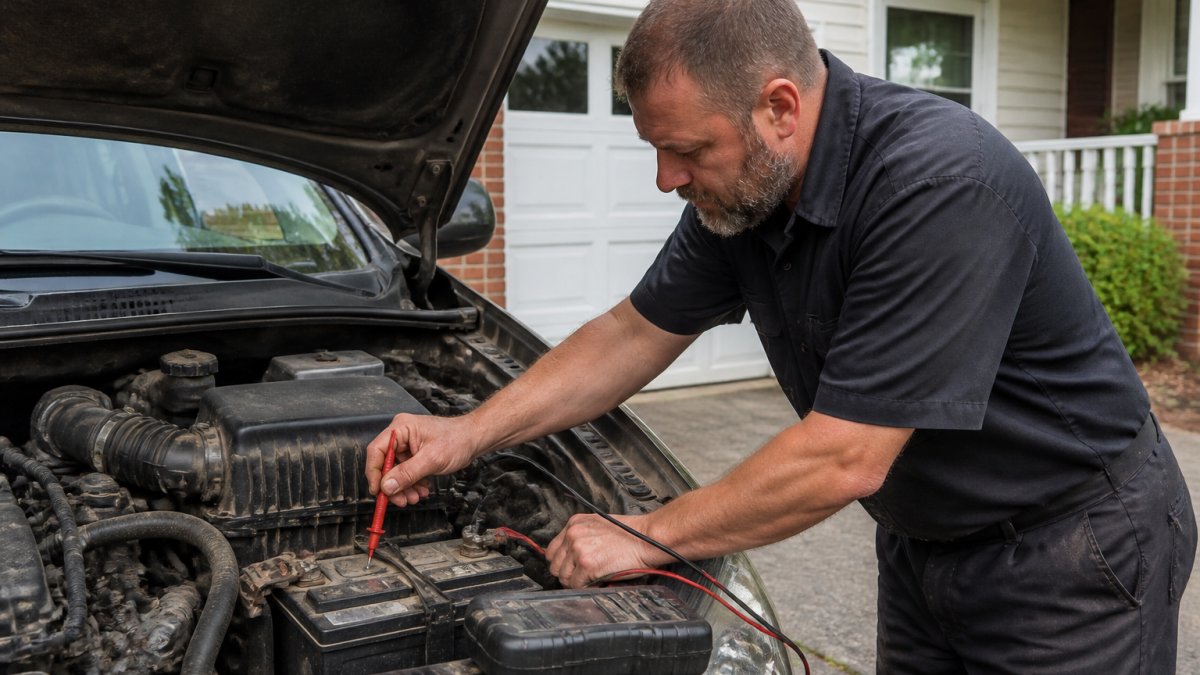
A skilled technician follows a sequence: verify the complaint, check for stored codes, test the battery and charging system, then perform voltage drop tests along the circuit.
Car Won't Start Electrical Problem: A Practical Troubleshooting Guide
When a car won't start electrical problem strikes, the fastest path is a simple three-check sequence. Work through these before calling anyone.
- Check the battery. Dim lights or a slow crank point to a weak 12-volt battery. Test voltage with a multimeter; a resting battery below roughly 12.4 volts is suspect.
- Check the connections. Loose or corroded terminals cause no-start conditions that mimic a dead battery. Clean and tighten them.
- Check the starter and ignition circuit. A single click with strong lights suggests the starter or its relay. No click at all often points to the ignition switch or a blown fuse.
If all three checks pass and the engine still will not fire, you have a fault that needs proper diagnostic testing. That is where on-site service earns its keep.
Mobile Mechanic Battery Replacement and Charging System Checks
Mobile mechanic battery replacement is one of the most requested on-site jobs, and for good reason.
The Bureau of Labor Statistics data cited by ConsumerAffairs' repair cost analysis shows vehicle maintenance and repair costs rose 6.5% in 2023.
A charging system check covers the alternator output, belt condition, and voltage regulator behavior. If the alternator is failing, a new battery alone will not fix it.
Car Battery Keeps Dying? What Repeated Drain Usually Means
A car battery keeps dying because something is drawing power when the vehicle is off, or because the charging system is not keeping up.
Common culprits include a stuck relay, a glove box or trunk light that never shuts off, an aftermarket accessory wired to constant power, or a failing alternator diode.
A 2026 repair-shop survey from IMR Automotive Research's repair shop challenges report found 23.8% of shops struggle to find qualified technicians.
EV and Hybrid Electrical Faults: What Changes On Site
EV and hybrid electrical faults change the safety rules, not just the tools. Electric vehicles run two separate electrical systems, and only one of them is safe for on-site work.
The Two Systems in Your EV or Hybrid
- The 12-volt system powers lights, infotainment, door modules, and, critically, the contactors that connect the high-voltage pack. A weak 12-volt battery in an EV can leave you with a car that will not "start" even though the traction battery is nearly full. This system behaves like a conventional car battery and is fair game for a mobile mechanic.
- The high-voltage system runs the traction motor, inverter, DC-DC converter, and charging port. It operates at hundreds of volts and can carry lethal current. Anything involving the pack, orange cables, the inverter, or the onboard charger belongs in a certified high-voltage bay.
A 2024 study in SAGE Journals on EV repair transformation notes that electric vehicles generally need less routine maintenance, but the repairs they do need are more specialized. That specialization is exactly why the 12-volt/high-voltage line matters so much on a driveway call.
What a Mobile Mechanic Can Safely Do on an EV or Hybrid
- Test and replace the 12-volt auxiliary battery
- Diagnose low-voltage module faults with a scan tool that reads body and chassis codes
- Inspect the charging port for debris, bent pins, or a faulty latch (visual and low-voltage only)
What Must Go to a High-Voltage Facility
- Any work on the traction battery pack, modules, or cooling circuit
- Inverter, DC-DC converter, or onboard charger replacement
- Orange-cable inspection, repair, or replacement
A survey reported by Aftermarket Matters on repair industry shifts found 39% of respondents encountered challenges with hybrid and EV battery packs, inverters, and isolation faults. Those are shop jobs, full stop.
A Safe Triage Sequence for EV Owners
- Note the warning message, not just the light. EVs display specific text, "12V battery low," "charging system fault," "high-voltage isolation fault." The wording tells you which system is involved.
- Check whether the car will enter "Ready" mode. If accessories power up but the car will not go into Ready, suspect the 12-volt battery or the contactor circuit before assuming a pack failure.
- Look at the charging behavior. A car that charges slowly on AC but fine on DC, or vice versa, points to the onboard charger or port rather than the pack.
- Stop if you smell coolant, see smoke, or notice a burning odor near the pack. Do not charge the vehicle. Move away and call the manufacturer's roadside line.
What On-Site Electrical Service Costs and How to Verify a Mobile Mechanic
Pricing for on-site electrical work depends on the fault, the vehicle, and the diagnostic time required. Here is how the costs actually break down, and how to verify the provider before you hand over a key.
How On-Site Electrical Pricing Is Structured
Most mobile electrical providers price in three parts:
- A diagnostic or call-out fee. This covers travel and the initial testing session. It is usually charged whether or not a repair follows, and it is the number to ask about first.
- Labor at an hourly rate. Diagnostic time on an intermittent fault can run longer than the repair itself. Ask whether the diagnostic fee is credited toward the repair if you proceed.
- Parts at list or list-plus markup. Ask for the part number and price in the written estimate so you can compare.
A parasitic draw that takes an hour of methodical fuse-pulling is a very different job from a starter replacement that requires removing an intake manifold. That is why flat published rates are rare, but a reputable provider will still give you a written estimate with a diagnostic fee, an hourly rate, and a parts allowance before work begins.
Factors That Move the Price
- Access. A battery tucked under a rear seat or a starter behind a manifold adds labor.
- Diagnostic difficulty. Intermittent faults and module communication errors take longer to isolate than a dead battery.
- Vehicle platform. European and EV platforms often require manufacturer-level scan tool subscriptions, which some providers pass through.
How to Verify a Mobile Mechanic in Five Minutes
- Confirm the business is a registered LLC with a real local address
- Ask about warranty terms in writing (ours is 12 months on repairs)
- Read recent customer reviews for no-show complaints
| What to Verify | Why It Matters | Red Flag |
|---|---|---|
| LLC registration | Accountability and recourse | Cash-only, no paperwork |
| Written warranty | Protects you after the repair | Verbal promises only |
| Diagnostic equipment | Finds the real fault | Parts-swapping approach |
| Shop backup plan | Job gets finished properly | Abandons half-done work |
| Local reviews | Shows reliability | Repeated no-show reports |
Questions to Ask Specifically About Electrical Work
- "Does your scan tool read body control module and chassis codes, not just powertrain codes?"
- "Do you perform voltage drop testing, or do you replace parts until the light goes out?"
- "Are you insured for on-site work, and can you send a certificate of insurance?"
Frequently Asked Questions
What car electrical problems can a mobile mechanic diagnose on site?
A mobile mechanic can test the 12-volt battery, charging system, starter circuit, fuses, relays, grounds, and accessible wiring in most vehicles. Diagnostic testing with a scan tool can read fault codes from modules that are reachable without a lift. Common findings include a dead battery, a failing alternator, a no-start condition from a bad starter or ground, and intermittent faults from corroded connections. Jobs that need a lift, a high-voltage bay, or extensive harness work are usually referred to a shop after the diagnosis.
Can a mobile mechanic replace a car battery or alternator at my location?
Battery replacement is one of the most common on-site jobs and usually takes well under an hour. Alternator replacement depends on the vehicle: on many models it is reachable from the top and can be done on site, while others require removing covers or accessories that are easier on a lift. The mechanic will confirm fitment and access before quoting. If the job cannot be completed safely where the car is parked, you should get a clear explanation and a referral rather than a half-finished repair.
When should you tow a car instead of calling a mobile mechanic?
Call for a tow when there is smoke, a burning smell, visible damaged high-voltage orange cabling, a fuel leak, or a vehicle that will not stay in park. A car that is not street legal or cannot be moved safely may still be a good candidate for mobile service, but a vehicle stranded in a live traffic lane should be moved by a tow operator first. For a car won't start electrical problem at home or in a parking lot, a mobile mechanic is often the faster and cheaper first step.
How long does an electrical diagnosis take, and what should I tell the mechanic?
A focused electrical diagnosis usually takes 45 to 90 minutes on site, depending on how intermittent the fault is. Tell the mechanic when the problem happens, whether it is worse in cold or wet weather, which warning lights appear, and any recent repairs or jump-starts. For a car battery keeps dying complaint, note how often it happens and whether anything was left plugged in. That history shortens diagnostic testing and reduces the chance of replacing a part that was not the cause.
Electrical faults rarely fix themselves, and a car that will not start can derail your entire week. At Chops Mobile Mechanic, we bring over a decade of experience to your location, backed by a 12-month warranty on repairs and honest diagnostics that find the fault instead of guessing. We serve drivers across the Hagerstown and Frederick areas with on-site repairs, emergency roadside assistance, and lockout help. Schedule now and get your vehicle diagnosed where it sits.